This essay draws from my experience helping shape the Sustainable Living Roadshow, a national collective operating at the intersection of climate education, culture, and public engagement. At the time, my role wasn’t defined by title (although my titles shifted from Coordinator of Chaos to King Midas to Executive Director), it was defined by the need to create structure inside complexity. This piece focuses on the moment when vision stopped being aspirational and became operational.
————————————
There was no shortage of energy in the room.
Weekly meetings were full of ideas, urgency, and shared conviction. Everyone cared deeply about the work. Everyone believed something meaningful was possible. And yet, nothing was really moving.
The problem wasn’t motivation. It wasn’t talent. It wasn’t even disagreement.
It was structure.
I’ve seen this pattern repeat in many forms since, but this was one of the earliest moments when it became clear to me: vision doesn’t fail because people don’t care. It fails when there’s no shared way to hold it.
Seeing the Future Before It Exists
At the time, we were a loose coalition of artists, activists, educators, and organizers trying to combine our individual efforts into something larger. Everyone had experience. Everyone had done impressive work on their own. But together, we were stuck in conversation.
What shifted things wasn’t a new idea. It was a decision to stop organizing around where we were and start organizing around where we were going.
I became less interested in describing our current reality and more focused on articulating a future state clearly enough that we could work backward from it. That future didn’t need to be guaranteed. It just needed to be legible.
Once we treated the future as a North Star rather than a promise, something subtle changed. We started speaking as if the thing we were building already had form. Not in an inauthentic way, but in a directional one. The future became a shared reference point instead of a personal vision.
That’s when momentum unlocked.
Making the Future Legible
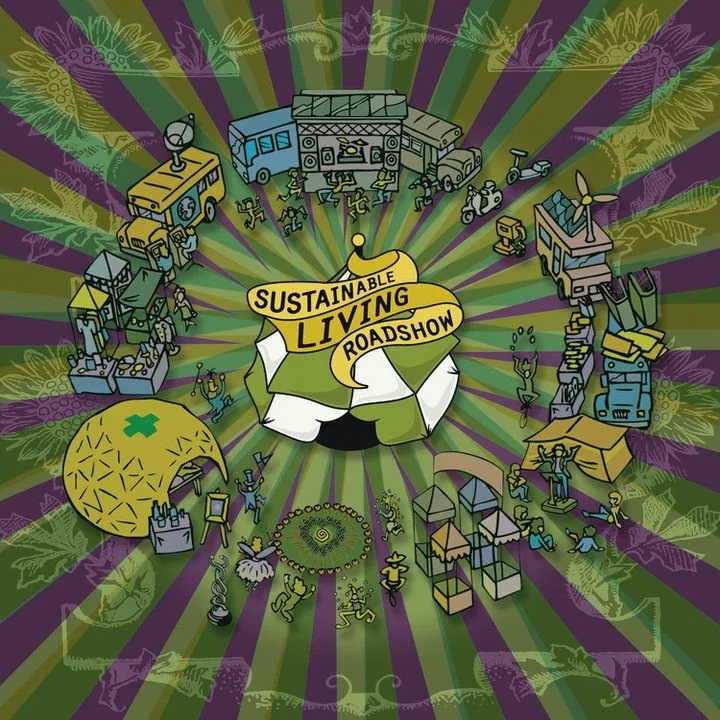
Turning complexity into a shared reference point.
The real turning point came when I stopped trying to explain the vision verbally and started externalizing it.
I needed a way to take everything we were carrying — skills, networks, values, constraints, aspirations — and make it visible. Not simplified. Visible.
Over a few days and sleepless nights, I built a large physical mind map that lived on a wall. It mapped who we were, what each group did at its core, how our networks overlapped, how we might fund the work, how we could organize locally while coordinating nationally, and how creativity and education could move markets over time.
It wasn’t a pitch deck. It wasn’t a plan. It was a system made legible.
That map became the source material for a single visual image that represented where we were headed. That image wasn’t just aesthetic. It became our brand, our planning tool, our way of communicating with partners, and our way of inviting others into the work.
Most importantly, it allowed people to act without waiting for me.
Designing for Collective Action
Once the future was visible, decisions that had felt overwhelming became straightforward.
We didn’t need to debate every move. We could ask simpler questions: Does this move us toward that future? Does this fit the system we’re building?
Resource needs revealed themselves naturally. Priorities clarified. Roles emerged. Partnerships made sense. Growth stopped being abstract and started being sequenced.
I wasn’t managing people into alignment. I was designing conditions that allowed alignment to happen. That distinction has stayed with me.
In complex environments, leadership often isn’t about directing execution. It’s about creating structures that allow other people to execute well, without constant intervention.
What This Reveals About How I Work
Looking back, this moment crystallized a pattern that has repeated throughout my career.
I’m an operational visionary. I work by aggregating complexity - ideas, people, constraints, systems, markets - and organizing it into something others can understand and act on.
I’m most effective when:
the problem is ambiguous
the path forward isn’t linear
and success depends on coordination rather than control
I don’t just think about what a brand or organization does. I think about how markets, policy, culture, and movements will interact with it over time - and how to design for that reality.
The goal is never to centralize power. It’s to distribute clarity.
The Quiet Lesson
Vision alone doesn’t scale.
Inspiration alone doesn’t hold.
What lasts is structure - not rigid systems, but shared frameworks that make the future tangible enough for people to move toward it together.
In my experience, the most durable progress comes when leaders stop trying to convince people to care and instead focus on designing systems that make caring actionable.
That’s where vision stops being fragile, and starts becoming real.